


Baltic states know Russian occupation is never temporary
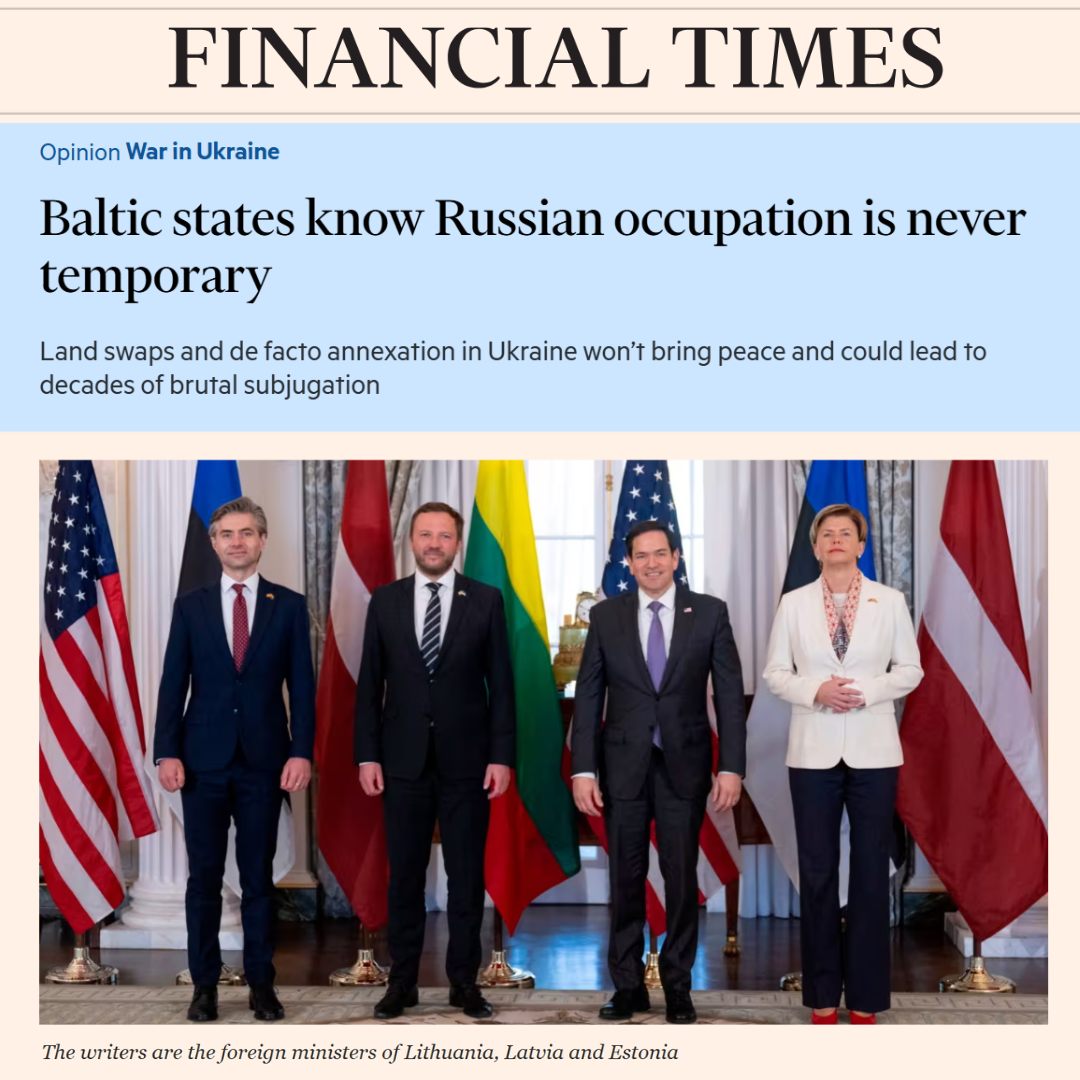
An insightful article authored by the Baltic Foreign Ministers, Kęstutis Budrys, Baiba Braže and Margus Tsahkna, published in the Financial Times.
Land swaps and de facto annexation in Ukraine won’t bring peace and could lead to decades of brutal subjugation
As the critical US-Russia summit in Alaska approaches, speculation about a possible territorial “swap” between Ukraine and Russia is surfacing. There have been claims that the occupation of parts of Ukraine would be “temporary” and only “de facto”, leaving hope for their return to Ukraine in the future. History warns us to think twice. The Baltic nations know what “only de facto” Russian occupation means — and that “temporary” can last half a century.
In 1939, Stalin and Hitler agreed to divide Europe under the Molotov-Ribbentrop Pact. Following that notorious deal, Soviet forces occupied and annexed Estonia, Latvia, and Lithuania in 1940, carrying out mass killings and deportations. The Nazi occupation in 1941 brought another wave of repression and the Holocaust. And reconquest by Soviet troops in 1944 brought further bloodshed and terror to Baltic soil.
Many western nations never formally recognised the Soviet annexation of the Baltics, thanks in part to the principled stance of the US. But for the 6mn Baltic citizens who lived through it, international legal nuances offered no protection from daily horror.
Over 25,000 people were killed in the underground resistance, more than 200,000 were deported to Siberia to starve in Soviet concentration camps and nearly 150,000 were forced to relocate to neighbouring communist countries. Some 43,000 children were abducted from the Baltic states; many grew up without knowing their origins. As the Red Army returned in 1944, more than 300,000 Baltic citizens were forced into immediate exile. Those who stayed endured aggressive Russification, mass in-migration and oppressive state control over education, work and private life. Even 35 years after independence was restored, the scars remain.
Currently, 6mn Ukrainian citizens live under Russian occupation in the regions Russia has seized by force. Those who have escaped report torture, imprisonment, mass surveillance, propaganda and other cruelties reminiscent of the Soviet past. According to official records, thousands of Ukrainian children have been abducted and are now fostered by Russian families and in institutions that erode their identity and damage their mental health. Thousands of prisoners of war and civilian detainees face daily torture and degrading treatment. And the mass graves in Bucha and Irpin reveal mass murder has been used as the ultimate instrument of intimidation and control by Russian occupying forces.
Today, nearly 300,000 civilians still live in the areas of the Donetsk region under Ukrainian control, and about 1mn remain in those parts of the Zaporizhzhia and Kherson regions where the Ukrainian flag still flies freely. The Baltic case offers a clear lesson: once Russia gains control, the cost of reversing it may be measured in decades of human suffering. “Temporary” occupation is not a holding pattern; it is a programme of systematic destruction of identity, freedom and life itself.
Sovereignty and territorial integrity are not abstract diplomatic ideals; they are the guardrails that protect people from the fate suffered by generations in the Baltics and now in occupied Ukraine. To entertain the idea of trading land for a fragile truce is to repeat the mistakes of the past — and to invite history’s darkest chapters to be repeated.
Putin’s goals have not changed. He aims to subjugate Ukraine, split allies and get a say over European security. The only sure path to lasting peace is through strength: unwavering transatlantic unity to sustain pressure on Russia, maximum support to Ukraine so it can defend its people and territory, and deep, sustained investment in our own defence and security. Only then will Moscow’s aggression be met with the one language it respects — resolve.


